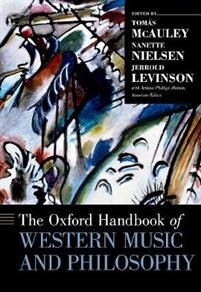
 The Oxford Handbook of Western Music and Philosophy
Edited by Tomás McAuley, Nanette Nielsen, Jerrold Levinson, and Associate Editor Ariana Phillips-Hutton
This Handbook offers an overview of the thriving interdisciplinary field of Western music and philosophy. It seeks to represent this area in all its fullness, including a diverse array of perspectives from music studies (notably historical musicology, music theory, and ethnomusicology), philosophy (incorporating both analytic and continental approaches), and a range of cognate disciplines (such as critical theory and intellectual history). The Handbook includes, but does not confine itself to, consideration of key questions in aesthetics and the philosophy of music. Each essay provides an introduction to its topic, an assessment of past scholarship, and a research-driven argument for the future of the research area in question. Taken together, these essays provide a current snapshot of this field and outline an abundance of ways in which it might develop in the future.
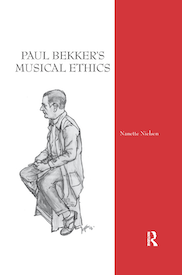 Paul Bekker’s Musical Ethics
Nanette Nielsen
German music critic and opera producer Paul Bekker (1882–1937) is a rare example of a critic granted the opportunity to turn his ideas into practice. In this first full-length study of Bekker in English, Nanette Nielsen investigates Bekker’s theory and practice in light of ethics and aesthetics, in order to uncover the ways in which these intersect in his work and contributed to the cultural and political landscape of the Weimar Republic. By linking Beethoven’s music to issues of freedom and individuality, as he argues for its potential to unify the masses, Bekker had already in 1911 begun to construct the ethical framework for his musical sociology and opera aesthetics. Nielsen discusses some of the complex (and conflicting) layers of modernism and conservatism in Bekker that would have a continued presence in his work and its reception throughout his career. Bekker’s demands for a ‘practical ethics’ led to his criticisms of metaphysically grounded approaches to aesthetics, and his ethical views are put into further relief in a sketch of the development of his music phenomenology in the 1920s. Nielsen unravels the complex intersections between Bekker’s ethics and his opera aesthetics in connection with his practice as an Intendant at the Wiesbaden State Theatre (1927–1932), offering a critical reading of an opera staged during his tenure: Hugo Herrmann’s Vasantasena (1930). Further works are considered in light of the theoretical framework underpinning the book, inspired by several intersections between ethics and aesthetics encountered in Bekker’s work.
 Music and Ethics
Marcel Cobussen & Nanette Nielsen
It seems self-evident that music plays more than just an aesthetic role in contemporary society. In addition, music’s social, political, emancipatory, and economical functions have been the subject of much recent research. Given this, it is surprising that the subject of ethics has often been neglected in discussions about music. The various forms of engagement between music and ethics are more relevant than ever, and require sustained attention. Music and Ethics examines different ways in which music can ‘in itself’ – in a uniquely musical way – contribute to theoretical discussions about ethics as well as concrete moral behaviour. We consider music as process, and music-making as interaction. Fundamental to our understanding is music’s association with engagement, including contact with music through the act of listening, music as an immanent critical process that possesses profound cultural and historical significance, and as an art form that can be world-disclosive, formative of subjectivity, and contributive to intersubjective relations. Music and Ethics does not offer a general musico-ethical theory, but explores ethics as a practical concept, and demonstrates through concrete examples that the relation between music and ethics has never been absent.


